
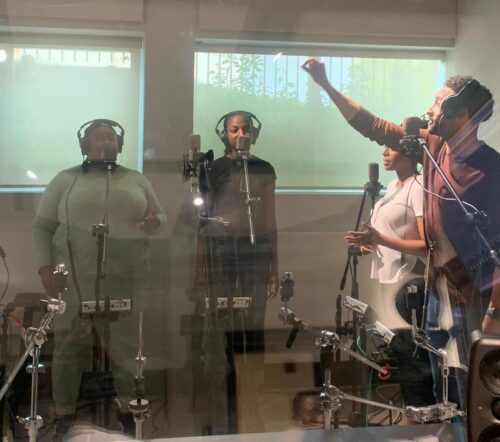
Behind the Scenes of Voice of the Lord
Good music is more than a beautiful melody or skilled instrumentation—it is a vessel that carries truth, stirs the soul, and draws us closer to God. Few projects embody this truth more than Voice of the Lord, the newly released single by the Kanisa Fellowship Ensemble.
The piece is not entirely new. Written by Renee Rowe over 20 years ago, it first debuted at the launch of Kanisa Fellowship, where it served as a special song—a melody that reflected both the church’s beginnings and its bold vision for the future. Two decades later, as Kanisa prepared to celebrate its 22nd Homecoming this past July, musician Daniel Rogers felt stirred to revisit the song. He reached out to Renee with a simple but powerful question: “What if we reworked this piece as part of the anniversary celebration?”
 What began as a conversation quickly unfolded into a collaborative production. Musicians, producers, drummers, vocalists, and church members rallied together, eager to bring the song back to life with fresh words, harmonies, and arrangements. The process was Spirit-led, unfolding verse by verse in the studio. Renee recalls walking into rehearsals unsure of how it would all come together:
“I didn’t know what the end product would look like,” she reflected, “but as we rehearsed, everything found its place.”
Behind the beautiful final recording was an entire community effort. Daniel spearheaded a fundraising drive to cover production costs, inviting the congregation to invest in a project that was more than just music—it was ministry. The finished song is not only a celebration of Kanisa’s history but also a reminder of what God can do when the body of Christ works together toward a shared vision.
Still, Voice of the Lord is about more than a polished recording. It is a testimony of faith, calling, and collaboration. To understand its deeper meaning, one must also hear the stories of its creators—their journeys in ministry, their struggles, and their growth.
Born to Sing
For both Renee Rowe and Daniel Rogers, music has never been a hobby—it has been part of their spiritual DNA. Growing up in Seventh-day Adventist homes, ministry was not simply a Sabbath activity but a lifestyle. Singing in choirs, attending rehearsals, and participating in worship were as normal as breathing.
Daniel, the son of a pastor, remembers mornings at home filled with song. His father would pull out the guitar and gather the family for worship, often while the children were still rubbing sleep from their eyes. “If we weren’t singing,” he recalls with a laugh, “our parents would say something. It wasn’t optional.”
Church life also kept him busy. Solos, choir duties, and worship leading often came his way—sometimes before he felt ready. “I didn’t even know if I was good,” he admits, “but if they told me to sing, I had to sing.” What might have felt like pressure at the time planted seeds that grew into a lifelong calling.
For Renee, the experience was similar. From as early as 10 years old, she was singing in choirs, with an unspoken assumption that every family member would serve in some capacity—whether as an elder, deacon, or chorister. “Ministry was just what we did,” she explains. Yet her perspective on worship shifted when she joined Faith Chorale at 19. There, she discovered that worship wasn’t limited to tradition. “My spiritual growth really deepened. It was so educational—being part of a group unafraid to go into different spaces and truly show Christ in what we did.”
What felt like indoctrination in childhood—being expected to sing, rehearse, and serve—eventually blossomed into a deeper passion. Both Renee and Daniel testify that those early seeds have become the roots of their present-day ministries.
Embracing the Gift and Calling to Ministry
For Daniel, music had always been present, but it wasn’t until adulthood that he truly recognized it as a calling. In university, stepping outside the “church bubble” gave him perspective. “I started to really see what it was like to rely on the Lord—and what it was like to be without Him.” That realization marked a turning point: music was no longer just performance; it became worship, a lifeline of faith.
Renee’s path into ministry was shaped by both discovery and disruption. She grew up listening to jazz greats like Ella Fitzgerald and Dinah Washington—artists she secretly ordered through magazine CD deals, to her parents’ bewilderment. A defining moment came during a road trip when she and her sisters heard You Brought the Sunshine by The Clark Sisters on the radio.
“It blew our minds,” she remembers. “It sounded like they were singing about Jesus—but it was also good music. It opened up our world to gospel in a new way.” That discovery, followed by groups like Commissioned and Richard Smallwood, awakened in her a passion for gospel that was both authentic and artistically excellent.
These experiences affirmed that her voice was more than a natural gift—it was a calling. As a young adult, she joined Faith Chorale, an experience that would shape her music journey. At one concert in Niagara Falls, choir director Sharon Riley asked her to step forward for a solo. Though terrified of microphones, she leaned entirely on God. “I opened my mouth, and it wasn’t me speaking or singing. It was like an out-of-body experience,” she recalled. From then on, she carried that moment as a testament to how God’s Spirit can transform worship and fill a room with His presence.
Leading Worship as a Test of Faith
Leading worship may appear effortless, but both Renee and Daniel emphasize that it carries deep demands. Worship leaders are human too, often walking through loss, illness, financial strain, and family challenges. Yet, they are called to stand before the congregation as vessels, guiding others into God’s presence.
“What makes a great worship leader isn’t just good musicality,” Daniel explains. “It’s being human enough to connect with people—to feel their needs and point them to Christ.” Renee agrees, adding, “Sometimes that means stepping away to rest, because no one can pour from an empty cup.” For both, self-care is not a luxury but a necessity to sustain ministry.
Why Record Voice of the Lord
So why revisit Voice of the Lord now? For Daniel, the answer is both simple and profound: while Kanisa’s music has always been powerful, its original songs rarely reached beyond the church walls. “Some of the best musicians and singers we know, have come out of Kanisa,” he explains, “but if you weren’t in the building, you’d never hear our originals.”
Recording the song, then, is about more than nostalgia—it’s about evangelism. “Worship inside the church edifies believers,” Daniel says, “but what about those outside who may never step foot inside? Music can reach them where they are.”
Renee echoes this conviction: “We don’t want rocks to do our job. If God has given us this gift, we should use it to share His love beyond the church.”
Both musicians also see the project as a continuation of Kanisa’s legacy. Daniel recalls being moved by Renee’s leadership years ago when she sang He’s Able during a service: “It was one of the first times I experienced worship where everyone was truly connected—emotionally and spiritually. It marked me.”
That same spirit carries into Voice of the Lord. The song honours Kanisa’s past, anchors its present, and points to its future—a reminder that worship is, and always will be, at the heart of the church.
Pursuing God Through Music
The production process of Voice of the Lord showed what’s possible when the right people serve in the right places. From fundraising to rehearsals, it was a lesson in collective ministry. The excellence of the final product reflects not only talent but also unity of purpose.
Looking ahead, both Renee and Daniel hope this is just the beginning. They envision Kanisa continuing to release original music and even reviving community initiatives like Praise in the Park, where worship spills out into public spaces, reaching those who may never enter a church.
“It’s not about money,” Renee says. “It’s about giving people a glimpse of who God is—through song, fellowship, and love.”
What’s Next for Kanisa Worship Arts
The success of Voice of the Lord is both a milestone and a launching pad. For the Worship Arts ministry at Kanisa, the challenge now is to build on this momentum—finding new ways to pour resources, creativity, and faith into projects that advance the gospel.
“We should never worship God with a mindset of scarcity,” Renee reflects. “If God has called us to this, He will provide. Our role is to give our all, trusting that He will replenish.”
As the church reflects on its 22-year journey, Voice of the Lord stands as both a tribute and a vision. It testifies that when God’s people embrace their gifts, collaborate in faith, and pursue excellence, worship becomes more than music—it becomes mission.